
In the marketing world there is no other KPI that is more valued in both short-term and long-term business decision-making than market share. This is because there aren’t many companies throughout the ages that have had a complete monopoly in their respective industry, and there are no companies that I can think of that have been able to maintain the ones that they have had.
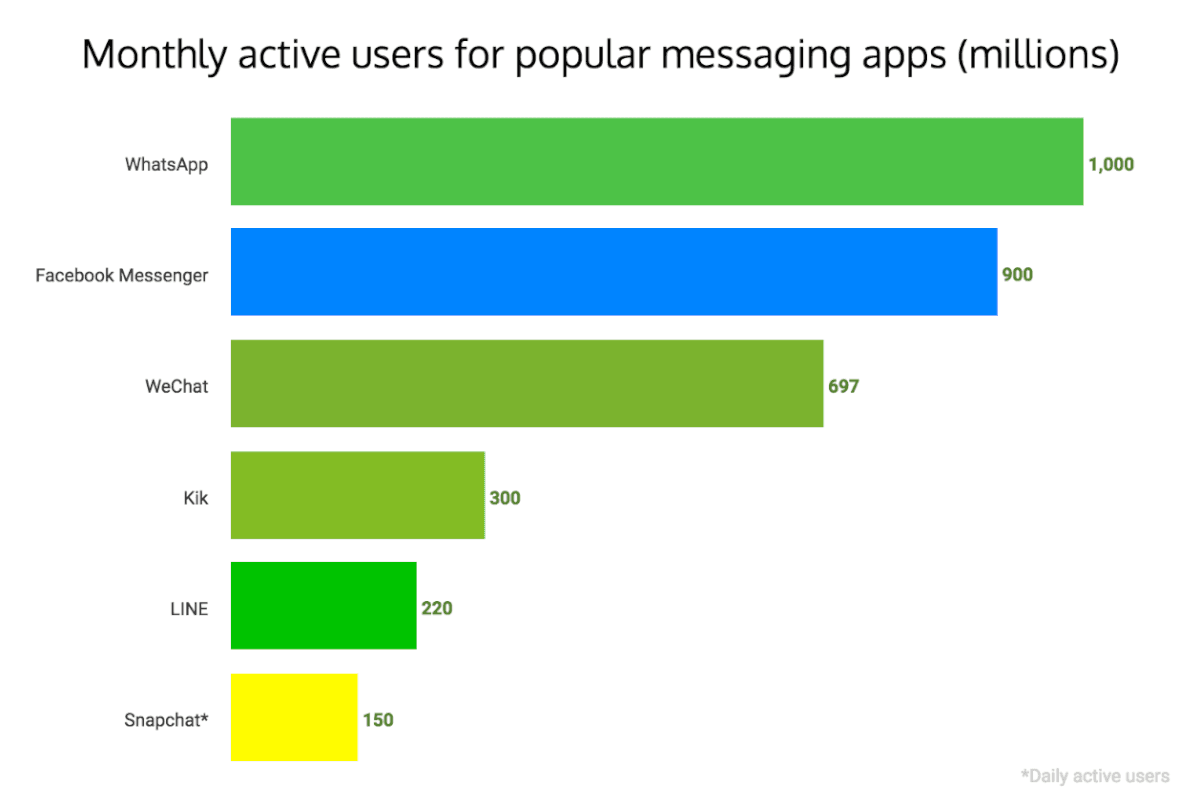
Kik is no stranger to competition. In my opinion this is key factor that has driven its innovation and that has also lead to its success over the years. Kik is one of many messaging apps that can be downloaded on a user’s mobile device. As far as messaging apps go there are quite a few that users can choose from, but for the sake of time we will only speak of the two that seem to be in direct competition with Kik. These two competitors are WhatsApp and Facebook messenger.
While Kik’s competitors currently enjoy pretty significant leads at the moment in the messaging app market, if we take the competitions parent company (Facebook INC) into consideration Kik is actually holding its ground very well. It has had steady market share increases of 8% or higher each year since 2011. Due to users new found concern with privacy issues that have recently been plaguing Facebook I believe they will gain even more in the years to come. Also where Kik differs is that it has a narrower target audience than its competitors targeting mainly teens and young adults.
There are other factors that come into play when we mention why Kik’s main competition has such a massive piece of the market share like the fact that Facebook’s has massive purchasing power. Whereas, Kik has mostly relied on its ability to reach investors to grow its business. Facebook enormity has also allowed it to pour enormous amounts of money into developing new and innovative tech, and also allowed them to buy start-up companies out before they even have a chance to compete against them.
Where Kik has shown its competitive advantage is in its ability to attract the younger generation of messenger app users between the ages of 16-23 years old. If they continue down this path there should be no reason why they won’t continue gaining more and more of the market share as Gen Zers continues to age.
Learn more about how Kik is competing by clicking here: https://www.stylus.com/ntfvhl
 Generation Z Marketing