
Guest Post

One of the beautiful things about social media in this day in age is the notion that there are very few barriers to entry, especially with the vast and dynamic start-up culture and gig economy that has been so prevalent for the last decade or so. When I start to analyze the Kik app, it feels like a throwback to the simpler times of myspace and AOL Instant messenger. The days where chat rooms created the anonymity that allowed users to freely be themselves with little repercussions that affect them in the real world.  As Seth stated in his post about the Gartner’s hype cycle that can be found at https://thesgblog.video.blog/2019/02/28/kik-is-climbing-the-slope/ he mentioned that the Kik app is currently climbing the slope, and since 2009 has been a smaller force in the game of social media channels. I think about the integration of Kik versus that of Snapchat or Instagram where there are multiple different functional attributes, where as Kik’s platform is much more simplified and began from the need to message from different devices. I also see a couple threats that could be causing the app to remain rather stagnant in it’s life cycle. The integration between real life and social media accounts have been more focused on self-promotion rather than just simplified messaging with strangers. This could also lead parents to not allow their children to use the platform, due to fear of online predators. With recent news about the MOMO challenge where someone hacked Youtube videos for children and placed a disturbing image of a woman with directions telling the children to run with knives or even commit suicide, the online community worldwide is tightening the reins. Many social media platforms like Facebook and even Instagram focus more on basing a user’s following off of people in their immediate social network versus interacting with strangers online, but also altering and framing their own image to fit a certain look or agenda. The days of chatrooms seems rather obsolete, but there is still a market for those who would rather stay behind a screen and keep the anonymous factor due to social complexity and or stigma. Many children developing their communication styles reach out to chat rooms out of curiosity, which in a way opens up a whole new can of worms when analyzing threats in the immediate environment. I believe if Kik wants to continue to be profitable, it will need to integrate more aspects into their platform, such as video sharing or even partner with another small scale channel to fine tune their target market, which then will they be able to fully understand the niche they are trying to capture. 

Marti is a current senior marketing major at Georgia State University with plans of graduating in May. She enjoys art, traveling, and live music.

To see more from Marti click on the link below:
https://martisheamedia.home.blog

About Kik Homepage Statement

Smartphones have become a part of us—always on, always within reach to connect us with our friends and our world.

Today, many teens and young adults are slowly moving away from social media and are looking towards chat as their primary source for communication and information. And where better to turn to for a fun, safe place to connect? Kik, of course!

Kik was founded in 2009 by a small but passionate group of University of Waterloo students. At the time, chat between Blackberry (yes, Blackberry), Android and iPhone users wasn’t possible, so we wanted to break down barriers and build a company that would allow users to chat with whoever, whenever.

Today, Kik is the best way to connect with friends, no matter where you meet them. But it’s also become so much more. As the only chat platform built especially for teens and as a clear leader in chatbots, Kik will become the central hub for everyday life for teens across the world as we grow.

To date, we’ve raised $120.5M from Foundation Capital, RRE Ventures, Spark Capital, SV Angel, Tencent (maker of WeChat), Union Square Ventures, and Valiant Capital Partners. With millions of users and an incredible team, our plans are well under way.

All information above was obtain from the below link click for more information: https://www.kik.com/about/

Kik Is Climbing the Slope

Kik has had its ups and downs since it was founded in 2009. The company has stayed innovative, and has come up with creative ways to keep its users involved. While my research shows that the company is doing well it has fallen in recent years from where it orginally was when it first hit the messenger app scene.

Kik is no longer in its “On the Rise” portion of its life cycle because it has already gone through its first round of venture capital funding, it has seen its name all over the media, and its early adapters have already come and gone. The company appeared to be “At its Peak” in 2012 when revenue was at its all-time high. It has also went through its “Sliding into the Trough” stage in the not too distant past when the messenger app market saw an increase of messaging apps.

It is my belief that Kik is now in its “Climbing the Slope” stage where it has identified its best practices and methodologies. Many of its users are just now seeing the abundance of uses Kik’s applications can provide to help them connect to others. Many different companies are now using Kik to fill up user’s message spaces with advertising and product knowledge. Kik has identified their target market and have done an amazing job reaching and impressing upon them. Kik has now set achievable goals and is steadily improving on its technology and processes as they go. They are also one of the leader’s in bot platforms, and they have designed their app to be safe and user friendly. All of these attributes point to the “Climbing the Slope” stage of Kik’s hype cycle.

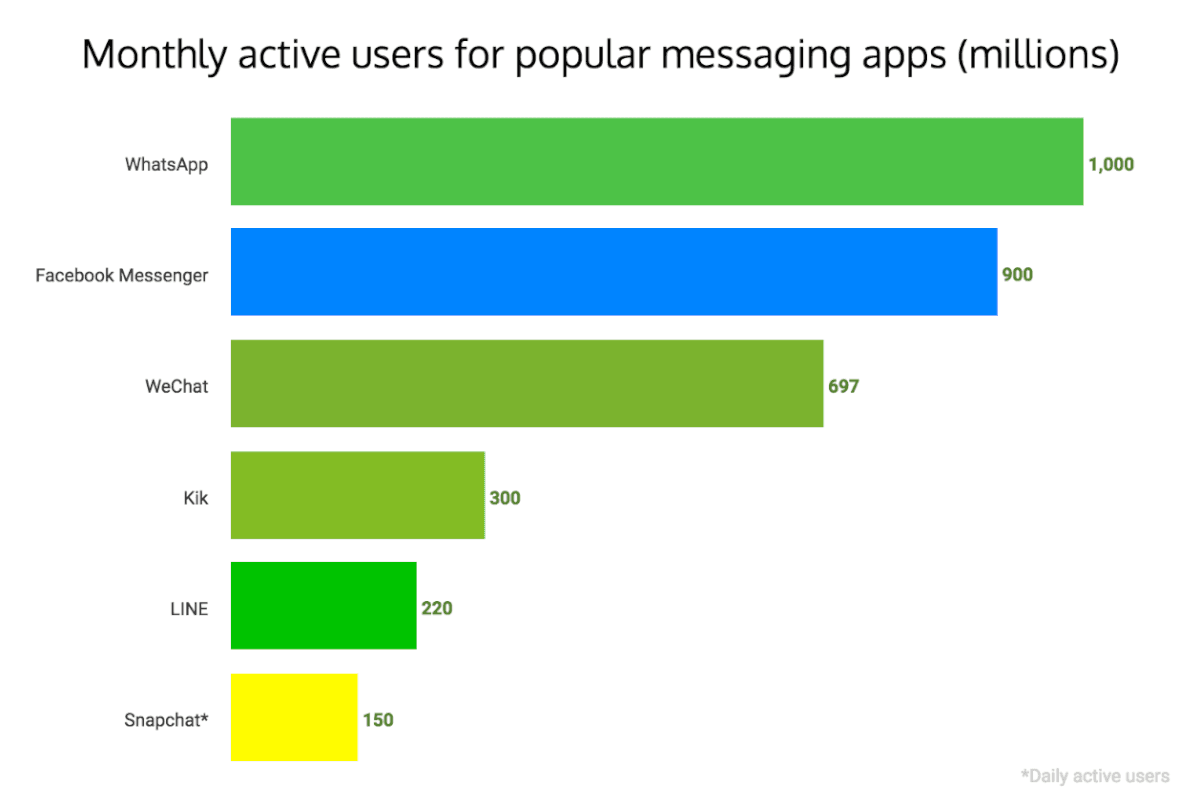
I do feel that they are at the beginning of this stage and have plenty of space to go up before they start plateauing in their productivity. The biggest threat that I see Kik having in today’s market is their competitions resources. To stay innovative and relevant they will have to continue to invest in new technologies that will keep them competitive and unfortunately for them they can’t keep up with apps like FB Messenger and WhatsApp at the moment

For more information on the Hype Cycle click the link: https://thinkgrowth.org/one-thing-everybody-forgets-about-gartners-hype-cycle-ecfe7e9de8ff

User Friendly Kik

In my previous post I spoke mainly about who Kik is competing against in the messaging app market. Now I want to speak to about why Kik isn’t your average messaging app. Kik advances in UI/UX/IA has made it so easy that even a child can navigate through its app without an issue. Through the use of Bots Kik has given its users unlimited access to his or hers favorite music, memes, videos, GIF’s, and all other web based information you can think of.

This is extremely important among their target audience of Gen Zers who feel that they need to share every part of their daily life experience. Kik’s Bot shop allows third-party developers to offer their own programmes to users in a similar fashion as Apple’s App Store and Google Play Store. This has proven to be an invaluable tool in attracting companies to use their platform to market their brands. For instance Sephora’s bot has tutorials on how to properly apply their products.

Kik also uses a strategic blend of graphics and text in their UI for their bot platforms, which many users like because it makes it easier to navigate. This is important to their users because Kik has more than 20,000 bots for its users to choose from. As I have discussed in some of my previous post Gen Zers have low attention spans and don’t like to focus on any one task for too long. The simple fact that Kik has 270 million users which are 18-23 shows that they have paid attention to their target market, and that they are making every effort to engineer UI platforms to keep them coming back. Another design aspect that has allowed Kik to increase its usage is the fact that it allows its users to go between its app and other social media platforms while saving information as they go.

Click on the link to view the Kik Bot Shop: https://bots.kik.com/#/

Competing in a Competitive Market

In the marketing world there is no other KPI that is more valued in both short-term and long-term business decision-making than market share. This is because there aren’t many companies throughout the ages that have had a complete monopoly in their respective industry, and there are no companies that I can think of that have been able to maintain the ones that they have had.

Kik is no stranger to competition. In my opinion this is key factor that has driven its innovation and that has also lead to its success over the years. Kik is one of many messaging apps that can be downloaded on a user’s mobile device. As far as messaging apps go there are quite a few that users can choose from, but for the sake of time we will only speak of the two that seem to be in direct competition with Kik. These two competitors are WhatsApp and Facebook messenger.

While Kik’s competitors currently enjoy pretty significant leads at the moment in the messaging app market, if we take the competitions parent company (Facebook INC) into consideration Kik is actually holding its ground very well. It has had steady market share increases of 8% or higher each year since 2011. Due to users new found concern with privacy issues that have recently been plaguing Facebook I believe they will gain even more in the years to come. Also where Kik differs is that it has a narrower target audience than its competitors targeting mainly teens and young adults.

There are other factors that come into play when we mention why Kik’s main competition has such a massive piece of the market share like the fact that Facebook’s has massive purchasing power. Whereas, Kik has mostly relied on its ability to reach investors to grow its business. Facebook enormity has also allowed it to pour enormous amounts of money into developing new and innovative tech, and also allowed them to buy start-up companies out before they even have a chance to compete against them.

Where Kik has shown its competitive advantage is in its ability to attract the younger generation of messenger app users between the ages of 16-23 years old. If they continue down this path there should be no reason why they won’t continue gaining more and more of the market share as Gen Zers continues to age.

Learn more about how Kik is competing by clicking here: https://www.stylus.com/ntfvhl

The Who’s and Why’s of Kik

Kik has taking a Star Trek approach to its social media presence in that it is going where no other platform has gone before. They have managed to be the pioneering platforms for the generation that has come to be known as “Z”. According to George Beall a contributor and analyst for the Huffpost “Gen Zers consist of those born in 1995 or later. They make up 25.9% of the United States population, the largest percentage, and contribute $44 billion to the American economy. By 2020, they will account for one-third of the population, and are certainly worth paying attention to.”

In the world today we see that what consider to be relevant is continuously being reshaped, and that Gen Z are thriving in a world of continuous updates. They have learned to process an abundance of information faster than any of the generations that have come before them thanks to apps like Kik. On the down side their attention spans have meaningfully decreased compared to those of Millennials. Gen Zers may not be able to focus well, but they are great multi-taskers. Any one that has teenage children I am sure is aware of this fact by now. Just last week I observed my twelve year old daughter and niece watching TV, while also watching a DIY YouTube vid on their iPads, and at the same time they both were researching topics for science projects on their iPhones. My first thought was “what the hell” but after a little probing I found out that they were actually retaining the information that they were receiving from all three medians.

While there is an ever increasing amount of Gen Zers that are getting smartphones many of them only have prepaid services, and are only able to utilize their device with the help of Wi-Fi. Unlike many other social media platforms Kik can be accessed strictly through the use of Wi-Fi without using a data plan. This is one of the many ways that Kik is differentiating itself from the competition. Also, many Gen Zers aren’t at the age where the parents are allowing them to have social media accounts or to have constant communication with others through the normal audio and text message channels. Kik allows for safe communication between teens and those they want to contact without having to give out there phone numbers which in return keeps them off their parent’s radar.

Learn more about the differences between Millenials and Gen Z at: https://www.huffingtonpost.com/george-beall/8-key-differences-between_b_12814200.html https://www.forbes.com/sites/deeppatel/2017/09/21/8-ways-generation-z-will-differ-from-millennials-in-the-workplace/